CGPA Calculator – Fast and Free for Students
The CGPA Calculator is a valuable academic tool designed for students from India, Bangladesh, Pakistan, and Malaysia to help them evaluate their academic performance with accuracy and ease. By entering their grades and credit hours for each semester, students can instantly convert their percentages into CGPA. This calculator provides a clear overview of academic progress, helping learners set realistic goals and make informed decisions to enhance their grades or CGPA. With just a few inputs such as course grades and credit hours, you can quickly calculate both your GPA and CGPA along with the equivalent percentage, ensuring you always stay aware of your academic standing.
What Is CGPA and Why Is It Important?
CGPA is more than just an academic score — it represents your overall learning journey. Institutions and organizations use it to gauge how consistently you’ve performed over time. With the help of this calculator, you can skip manual computations, avoid spreadsheet errors, and get precise results in seconds.
Different education systems follow different scales. For instance, many Indian universities use a 10-point CGPA system, while international institutions often follow the 4-point GPA scale. This is why tools like GPA-to-CGPA and CGPA-to-percentage converters are widely used by students who need to align their scores with admission or job requirements.
For official guidelines, you can check the UGC Grading System in India.
Example: Manual Calculation vs. Automated Calculation
Suppose your SGPA scores for three semesters are 8.5, 7.9, and 8.1.
- Add them together: 8.5 + 7.9 + 8.1 = 24.5
- Divide by the number of semesters: 24.5 ÷ 3 = 8.16 CGPA
If courses have different credit values, doing this by hand gets messy. A CGPA calculator with credits automatically weights each subject and saves time.
How to Use Our CGPA Calculator
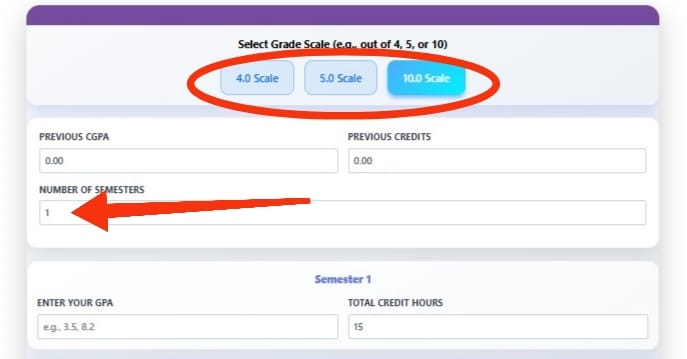
- Select Your Grading Scale
Choose your university’s grading system:- 4.0 Scale – For Pakistani universities
- 10.0 Scale – For Indian universities
- 5.0 Scale – For some European and African institutions
(Default is set to 10.0)
- Enter Previous Academic Details
Add your previous CGPA and total credits if you’ve completed any semesters.
Leave both as 0.00 if you’re starting fresh. - Add Number of Semesters
Enter how many semesters you want to calculate (up to 15).
The calculator will create input fields for each one automatically. - Input GPA and Credits
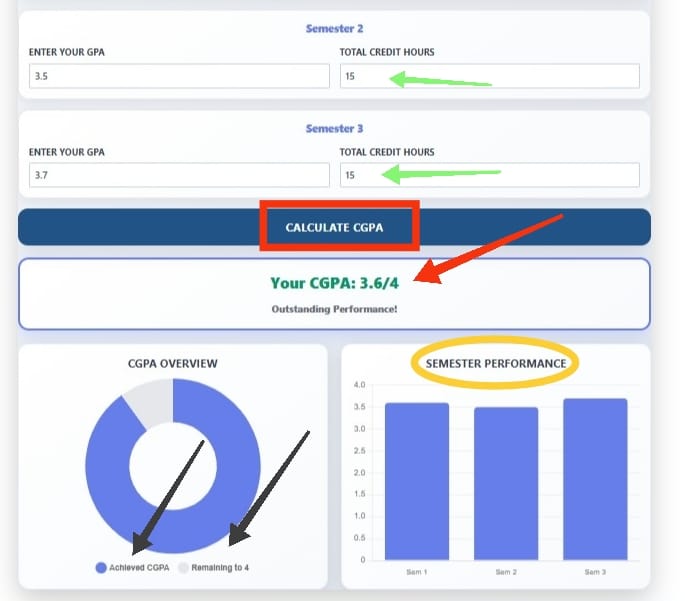
For each semester, type your GPA and credit hours.
Make sure the GPA doesn’t exceed your selected scale. - Click “Calculate CGPA”
Press the Calculate CGPA button to view your result.
You’ll instantly see your CGPA and performance charts for better visualization.
Understanding the Results of Our CGPA Calculator
- Numerical CGPA – This shows your final cumulative GPA after the calculation. It displays the exact CGPA value based on the data you entered, reflecting your overall academic performance.
- Performance Levels – The calculator also provides a color-based indicator to help you understand your performance more clearly:
- 🟢 Exceptional: 90–100% of the scale
- 🔵 Excellent: 80–89%
- 🟡 Good: 70–79%
- 🟠 Average: 60–69%
- 🔴 Needs Improvement: Below 60%
These performance levels make it easier to interpret your CGPA at a glance and track how well you’re doing across semesters.
CGPA Calculation Tips for Accurate Results
- Accurate Data Entry – Always double-check your inputs before calculating. Confirm that your GPA values are correct, match the credit hours with your transcript, and use decimals for precision (for example, 8.67).
- Using Previous CGPA – If you’ve already completed some semesters, enter your previous CGPA in the “Previous CGPA” field and total credits in “Previous Credits.” Then add your new semester details — the calculator will automatically update your final CGPA.
- Scale Selection – Choose the correct grading scale for your university.
- 4.0 Scale – For Pakistani universities
- 10.0 Scale – For Indian universities
- 5.0 Scale – For some European or African universities
The calculator adjusts your results automatically and allows you to switch scales anytime.
Grading Scale Reference Chart
| Feature | 4.0 Scale | 5.0 Scale | 10.0 Scale |
|---|---|---|---|
| Outstanding | 3.6 – 4.0 | 4.5 – 5.0 | 9.0 – 10.0 |
| Excellent | 3.2 – 3.5 | 4.0 – 4.4 | 8.0 – 8.9 |
| Good | 2.8 – 3.1 | 3.5 – 3.9 | 7.0 – 7.9 |
| Average | 2.4 – 2.7 | 3.0 – 3.4 | 6.0 – 6.9 |
| Needs Improvement | Below 2.4 | Below 3.0 | Below 6.0 |
Why Use an Online CGPA Calculator Instead of Manual Calculation?
Calculating CGPA manually can be confusing and time-consuming, especially when multiple semesters and credit hours are involved. An online CGPA calculator makes this process quick and accurate. With just a few clicks, students can get instant results without worrying about mathematical errors.
Online CGPA calculators also support different grading systems — such as 4.0, 5.0, and 10.0 scales — making them suitable for universities across India, Pakistan, Bangladesh, and Malaysia.
Here’s a quick comparison:
| Feature | Manual Calculation | Online CGPA Calculator |
|---|---|---|
| Time Taken | Long and requires formulas | Instant results |
| Accuracy | Prone to human errors | 100% precise |
| Supported Scales | Usually one system | 4.0, 5.0, 10.0, etc. |
| User Convenience | Needs calculator and effort | Simple and automatic |
Benefits of Knowing Your CGPA Early
Tracking your CGPA regularly helps you stay aware of your academic progress and plan ahead. When you know your CGPA early, you can identify subjects where you need improvement before it’s too late.
A good CGPA also plays a major role in your future opportunities. Students applying for scholarships, internships, or higher education abroad often need to provide their CGPA or convert it into a percentage or GPA format.
By checking your CGPA early, you can set realistic academic goals, manage your study plan effectively, and stay motivated throughout your course.
Difference Between GPA, SGPA, and CGPA
Many students get confused between GPA, SGPA, and CGPA. While they sound similar, each represents a different stage of academic measurement.
| Term | Full Form | Description |
|---|---|---|
| GPA | Grade Point Average | The average of grades for one semester. |
| SGPA | Semester Grade Point Average | Similar to GPA, used interchangeably in some universities. |
| CGPA | Cumulative Grade Point Average | The overall average of all semesters combined. |
In short, GPA or SGPA focuses on one semester’s performance, while CGPA represents your overall academic achievement over time.
CGPA Conversion Tools You Might Need
Students often need to convert grades into different formats depending on university or job requirements. Here are some useful conversion tools that make this process easier:
- GPA to CGPA Converter – Convert your Grade Point Average into Cumulative GPA.
- CGPA to Percentage Converter – Quickly find your equivalent percentage score.
- SGPA to CGPA Calculator – Combine all your semester GPAs to find your total CGPA.
- University-Specific CGPA Calculators – For example:
Common CGPA Calculation Mistakes to Avoid
Even small mistakes can lead to big differences in your final CGPA. Make sure to avoid these common errors:
- Using the wrong grading scale (e.g., choosing 10-point instead of 4-point).
- Ignoring credit hours, which can change your weighted average.
- Entering incorrect previous CGPA or credits when combining semesters.
- Skipping failed or repeated courses, which still affect your overall CGPA.
How CGPA Affects Your Career Opportunities
Your CGPA is not just a number — it reflects your consistency, discipline, and academic strength. Employers and universities often consider CGPA as a key indicator of a student’s performance.
A strong CGPA can open doors to:
- Academic scholarships and merit-based awards
- Internship opportunities during your studies
- Admission into top postgraduate programs
- Better job placements after graduation
Top Universities and Their CGPA Grading Systems
Every country and university follows a slightly different CGPA scale. Knowing your institution’s system helps you calculate and compare your scores accurately.
Here’s a quick overview:
- India (10-point scale): VTU, Anna University, Mumbai University
- Pakistan (4-point scale): UAF, GCUF, Punjab University
- Bangladesh (4-point scale): BRAC University (BRACU), IUB, NSU
- Malaysia (4-point scale): University of Malaya (UM), UTM
Tips to Improve Your CGPA
Improving your CGPA takes consistent effort, smart planning, and discipline. Here are some simple yet effective tips:
- Attend all classes and tutorials to avoid missing important concepts.
- Review previous exams and assignments to understand your weak areas.
- Focus more on credit-heavy subjects since they have a bigger impact on your overall CGPA.
- Ask professors for feedback to identify where you can improve.
- Balance your study schedule to avoid burnout and maintain steady progress.
Frequently Asked Questions
How to calculate CGPA from SGPA?
CGPA (Cumulative Grade Point Average) is calculated from SGPA (Semester Grade Point Average) by taking the weighted average of all semester SGPAs. First, multiply each semester’s SGPA by its respective credit hours to get grade points. Then add up all the grade points from all semesters and divide by the total credit hours completed. For example, if Semester 1 has SGPA 8.0 with 20 credits and Semester 2 has SGPA 8.5 with 22 credits, your CGPA would be [(8.0×20) + (8.5×22)] ÷ (20+22) = 347 ÷ 42 = 8.26.
How to calculate CGPA from marks?
To calculate CGPA from marks, you first need to convert your marks to grade points according to your university’s grading scale. Each subject’s marks correspond to a specific grade point (for example, 90-100 marks = 10 grade points, 80-89 marks = 9 grade points, etc.). Multiply each subject’s grade points by its credit hours, add all these values together, and divide by total credit hours. This gives you the semester GPA. Repeat this process for all semesters, then calculate the overall CGPA by taking the weighted average of all semester GPAs based on their credit hours.
How reliable are online CGPA calculators compared to university calculations?
When the correct data is entered, modern CGPA calculators deliver results that are nearly identical to official university records. The level of accuracy, however, depends on using the right grading scale and credit system for your institution. For applications like scholarships or admissions, always cross-check the calculator’s output with your official transcript.
What if my calculated CGPA is different from what’s shown on my transcript?
Start by reviewing your inputs carefully, including grades, credits, and grading scale. Mistakes often happen with repeated courses, transfer credits, or when special academic policies are applied. If you cannot identify the issue, the best step is to reach out to your university registrar or academic advisor for clarification.